(Learning How to Die)
Building an Apology: Work View + Life View
10/4/26
Work View
I decided years ago that I’ll never again work a job I don’t like just for the money. To me, work is something that you enjoy doing despite the difficulty of it. You can be drenched in sweat, literal or metaphorical, and feel satisfied. It’s like family or a marriage. You might not always be happy with a person, you’re going to disagree, you’re going to struggle through circumstances. But at the end of the day you love your family. Likewise at the end of the day you love your work. It’s what makes you you, where your soul, your unique identity can sing, can radiate. Your work is etched into your being, just as family is. You can lose track of time doing it. And before you know it are getting paid for doing it so much and so well. While your soul sings, you are benefiting society. A carpenter who loves making furniture makes better furniture than one who does it for the money or because nobody else wants to. This balance is like pulling three or four circles that naturally drift apart together into one concentric lense. An economy embedded in a society where more people love their work, will be a much more productive economy. There would be less forced productivity. Instead you would be begging people to take a break. For me this would be writing for social change and ecological farming. What would it be for you?
Life View
When I think of the meaning or purpose of life I think of what it means to be human. Jazz, poetry, and movies capture this well. To be human is to love, to struggle, to learn lessons, to love more, to look at green and living things and breathe deeply, to do the things that make you levitate, that make your heart sing. These are the things that bring us closer to God, because they let us be closer to our true identity. To be human is to consider our finiteness, humility, and decide accordingly what we must do with the brief contribution of our life. Evil exists to test people and make them truly good. Withstanding lots of suffering understandably makes one want to give up hope, to do harmful things. It is very human is to want to escape from suffering. But when we lean into suffering we stumble into Jesus Christ. The presence of evils does not mean the absence of good, nor the absence of God. They are a chance to become something better in spite of them, because they exist. This is also very Godly- to transform the evil, the waste, the dead, into goodness, into fertilizer, into new life. That’s the meaning of life. And then, ultimately, symbolically, literally, that happens to us one more time when we die.
Read this if you struggle to embrace the Old Testament (but it still might not help)
5/8/26
For years I have quietly renounced the first books of the Bible, with their hundreds of mind-boggling rules and the sickening sins such as infidelity, murder, sexual abuse, conquest, genocide, commited by biblical figures and sometimes at the instruction of God. Reluctantly returning to the Old Testament, I first felt as though these stories are normalizing, rationalizing, these sins. I was filled with fresh new rage, weighing these sins with how our world is today, with how some Christians are today. Our world begs us to rationalize and reason our way into sinning. So imagine my frustration. I’m trying to be good when everything around me suggests I should be sinful, dog eat dog, take from others in the zero sum game. I go running to the Bible for refuge and only find more of the same. I asked myself, Why can’t the Old Testament be a series of stories where our forefathers and mothers were tested, tempted to sin but, through mental fortitude and resilience, overcame that temptation? That’s what I need to hear.
However difficult the pill is to swallow, there is an important truth here: we are that way. Humans are, and we always have been that way. Since those very first Bible stories, we have been flawed, hailing from broken and messy families, reasoning our way into more sin and breaking the world further.
The Old Testament is there to say although we humans are flawed and do evil things, God remains strong, present, and hoping for our return.
After the patience of 1,000 years, or 1,000 pages, Jesus is the one who fulfills what I was craving. He is faced with temptation. Taking on our human form, Jesus feels hunger, thirst, deep sadness, overwhelming rage. In spite of it all, Jesus never let those feelings push him into sin, like our ancestors of the Old Testament were, and like we are pushed today.
In fact there are a lot of hidden ways in which Jesus and the New Testament fulfills the yearning created by the Old Testament. Here are just a few.
- God always chooses the marginalized. God chose Ruth a widow and outcast with no family to run to, to be an exemplar of loyalty, faith, and friendship. God chose David, a little shepherd boy, to defeat Goliath and be anointed king. These are the stories we must carry in order to appreciate the deep truths of the New Testament. How so? Jesus is born into the lineage of a carpenter from Bethlehem, raised in Galilee, the margins, when people said that nothing good can come out of Galilee. “The stone that the builders rejected has become the cornerstone” (Psalm 118:22)!
- Another yearning introduced in the Old Testament is the human desire for a worldly king and conquest. In the Old Testament God even mandates conquest and subsequent genocide. What can we make of that? Let’s be absolutely clear that these stories of conquest are never meant to condone any form of violence. They are dramatic stories meant to make a point. After conquest the warriors would be tempted to sack jewelry, add to their stores of food, add animals to their farms, to take new wives. These aspects of ancient war symbolize sin, taking advantage of worldly pleasures instead of the higher things to which God calls us. This is why God ordered these cities to be burned and all living things to be wiped out after conquest. This took place under Joshua. This is what many Jews wanted in the times of Jesus, a new conqueror king. Jesus, whom we know as Yeshua, our spiritual conqueror, victor, liberator, emboldens us saying, “In the world you will have trouble, but take courage, I have conquered the world” (Jn 16:33). Christ, our only true king, brings the same rigidity and discipline to his disciples’ personal lives saying, if your left hand causes you to sin then cut it off (Mt 5:30), if your eye causes you to sin then pluck it out (Mt 8:9), if you look at someone with lust you have already sinned in your heart (Mt 5:28). The point from the Old Testament, fulfilled and doubled down by Jesus, is a strict inner discipline, a war within each person that leaves anger, hate, and sin with no place to dwell in our hearts.
- The Bible speaks to us about signs and wonders, beginning back with Moses’ ministry, continuing and culminating with Jesus’ ministry. After Easter, when Jesus is resurrected, we’re looking back on the cross the same way the Israelites looked back over the Red Sea. The Red Sea is a symbol of enslavement and being trapped, a reminder of their enslavers. The cross is a symbol and a physical tool of death. Though daunting and dangerous, the very thing we are looking back over means our liberation, because God has conquered it.
This is a relatively simple truth. Old Testament figures were flawed, and Jesus, who was without sin, came to break that cycle. Yet it takes on new meaning when I relive all these pages of the Old Testament, a lifelong undertaking, a lifelong study, and I bring to the Scripture my frustrations as I mature and experience the world moving and changing. My simple conclusion, that 2nd grade religion class could have taught me, and probably did, has new and more profound meaning for me today. That is the purpose of studying scripture, that our relationship with God be ever under construction. It is necessary to study the faith, the stories, always weighing everything with the examples of Jesus and with the law written on our own hearts. This study is a lifelong commitment to always be learning more, sacrificing our time and devotion to God. When we do, God will continually bless us with wisdom and direction.
Black People and the Bible
2/28/26
I once heard a friend joke that “every country has a plan for Africa, meanwhile Africans are just trying to get to Heaven.” The Gospel of Matthew Chapter 5 verses 38-48 give us some of the most difficult commands of religious life. Don’t retaliate when someone harms you. Go the extra mile beyond what you owe to someone. It’s Africans and people of African descent, trying to get to heaven, who have largely mastered them. But we have long debated whether we should or shouldn’t be cultivating such practices.
Teaching About Retaliation. 38 [a]“You have heard that it was said, ‘An eye for an eye and a tooth for a tooth.’ 39 But I say to you, offer no resistance to one who is evil. When someone strikes you on [your] right cheek, turn the other one to him as well.”
It’s so unnatural to receive an offense and respond with love. It’s so against our human nature to act with love after being wronged or physically harmed. We are tempted to investigate who actually started it, who owes whom, who was justified, but this is not what Jesus instructs. We are supposed to not only lay down our arms, but also to go so far as to bury the hatchet. You could say by reciprocating violence that justice is served, but if the result is that everyone is hurt and bitter, is it worth serving justice? Is that true justice? The scripture points us to a resounding no. We see the above verse often, but the age-old flaw of Christians, myself included, is that we forget to read on. The very next verse-
40 “If anyone wants to go to law with you over your tunic, hand him your cloak as well.”
When something is owed, as a baseline we should listen earnestly to their argument. This verse calls us to give doubly, to give what is owed and more.
41 “Should anyone press you into service for one mile,[b] go with him for two miles. 42 Give to the one who asks of you, and do not turn your back on one who wants to borrow.”
This verse restates the call to give of ourselves doubly, but this imagery reminds me of the sheer difficulty and the value of a mile-long walk through another person’s struggles, helping them carry their cross knowing you have your own. Imagine the understanding we would have of our “enemy” if we literally went to that level of empathy, of solidarity, in their struggles.
Case in point, this small piece of scripture is heavy and profound. Whenever we are wronged it’s an invitation to be like Jesus and forgive. To put oneself above the very human inclination toward retribution. But hand in hand with that statement is the invitation that whenever owe something to someone we are invited to give generously.
You may be thinking, this is all good in ideology, in theory. Turn the other cheek. Show radical love for even your transgressors. Dr. King talks about loving the world, loving the racists, the descendants of your ancestors’ enslavers, the true strength it takes to love. But what about someone who violates your family, your partner? What if you are a head of state and someone has disrespects your nation, perhaps kills a citizen of yours? Not such an easy choice anymore (as if it was before). Where else could I go with this besides Malcolm X, who takes particular offense to such verses in the Christian Bible. He criticizes any principle that tells Black people to endure suffering in this life, because heaven is waiting for you in the next. Meanwhile people are benefiting from your suffering and servitude, and get to enjoy their heaven now. Malcolm X says in practice, somebody hits you, you have earned your lick back, and while we’re at it let’s reject and eject ourselves from such a wicked system.
And thus a deep philosophical debate becomes real. Many people regardless of race agree that if someone hits you you are owed at least one hit back. This was the fear in White Americans minds that if we were to put that philosophy, morally justified and supported by many, into practice in a country whose wealth was built on enslavement and continued brutality and subjugation against Black people, this nation could, justifiably, tear itself apart in violence. That was why people feared Malcolm X who fearlessly spoke truth to power. Another example, for all those who grew up in families with physical violence between siblings as normative, you know that it’s difficult to measure who hit first who hit harder vs whose was fair. Thereby you descend into chaos until your parent steps in.
But how many of us grew up in families where your sibling asks you for water and then, upon realizing you actually love them, you bring them water with ice, a stem of mint, and drops of lemon juice (just me and mine)?
Do Black people have our eyes on the prize or are we simply getting tossed around by the currents created by others? Enter the Afro-descendent people, who, trying to get to heaven, have tapped into a spiritual wisdom and pattern of acting beyond regular human understanding. I was studying the teachings of the great Prof. Cornel West, while at the same time reading the Autobiography of Malcolm X, when I realized that the true and greatest evil of slavery was making it as hard as possible for us to love. But look at how we’ve triumphed in God’s war against hate!
Perhaps it is because of a widespread desire to understand the divine, that which transcends the human condition, that allowed us to welcome in our oppressors, to treat them with mercy, that continues today. Having studied the Bible my whole life, I can’t help but look at my people, Black people around the world, as having achieved a greater feat of understanding and practice of biblical principles. So while others have schemed and exploited African and Afro-descendant peoples for centuries, perhaps by continuing to love ourselves and our oppressors, even as they continually commit to forgetting their own debt and obligations, we have reserved for ourselves heaven both in this life, as we choose to be joyful and loving, and in the next as we boldly obey Jesus’ commands.
Love and Revolution
9/30/25
I easily see connections between revolutionary thinkers and taking care of the earth. With a reading list like this, how could I not?
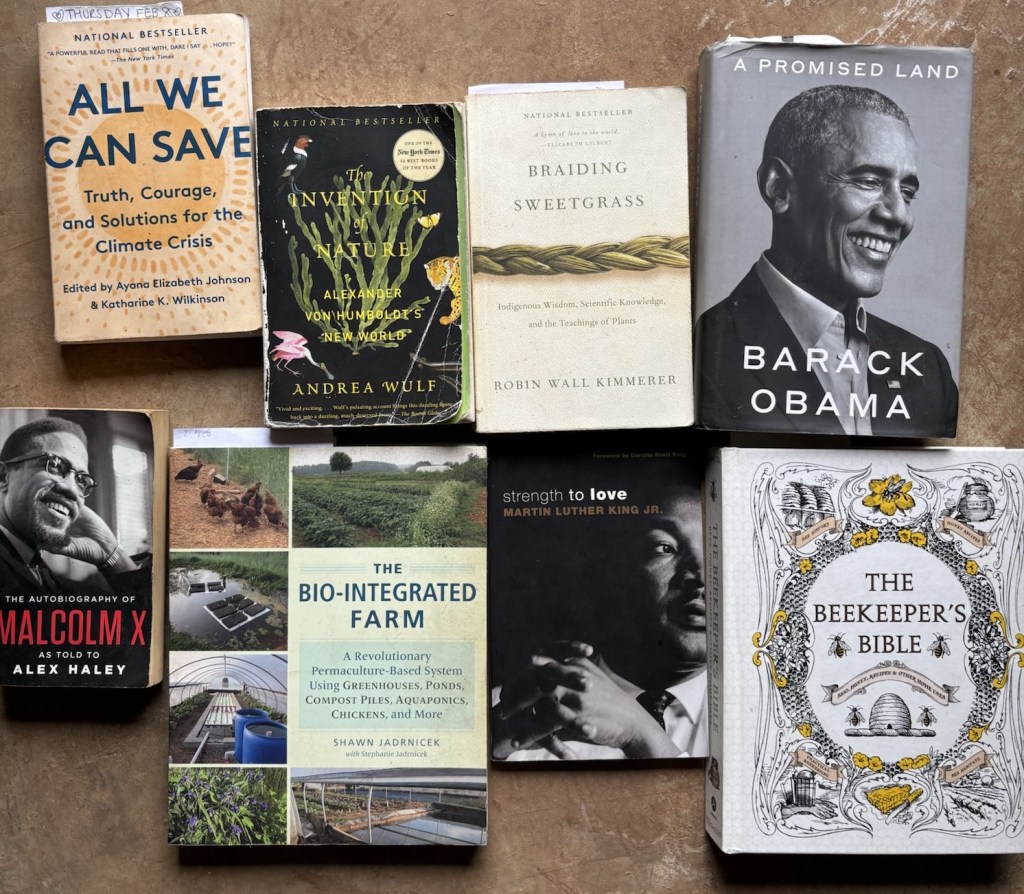
I am reading Che Guevara, Malcolm X, Kimberlé Crenshaw, Cedric J. Robinson combined with Robin Wall Kimmerer and Jane Goodall. These revolutionaries, Black activists, and environmentalists build my arsenal of weapons and words to advocate for justice. Meanwhile I’m combining economic advancement with food security and environmental care. I am knee deep in the practice of liberation— liberation through nutrition and connection with the land.
When we make these easy connections we transform reality.
It’s easy to recognize that timber and fruit are not a given, but gifts, and by doing so we deconstruct the harms of a capitalist society. It’s easy to see how food autonomy deconstructs harmful imperialism. Our society and our economy transform when we see the dignity of humans and wildlife in ways that transcend game theory, overconsumption, and even utility maximization.
I notice that revolutions of the past lack a manifestation of central, radical love. Imagine if a revolution centered Black love, a love that spills over into loving one’s oppressor. This is what John Lewis talked about. This is what Dr. King talked about.
It’s easy for me to see love, and this revolution that we need, to come through and for the love of the earth. Restoring Black love through connection with the land, at least starting with me, has felt powerful. That’s a love so radical and so healing, a love that motivates hard work, and that motivates sharing the fruits of your labor. Love that spills over.
This is how I stand on the shoulders of giants. This is revolution.

